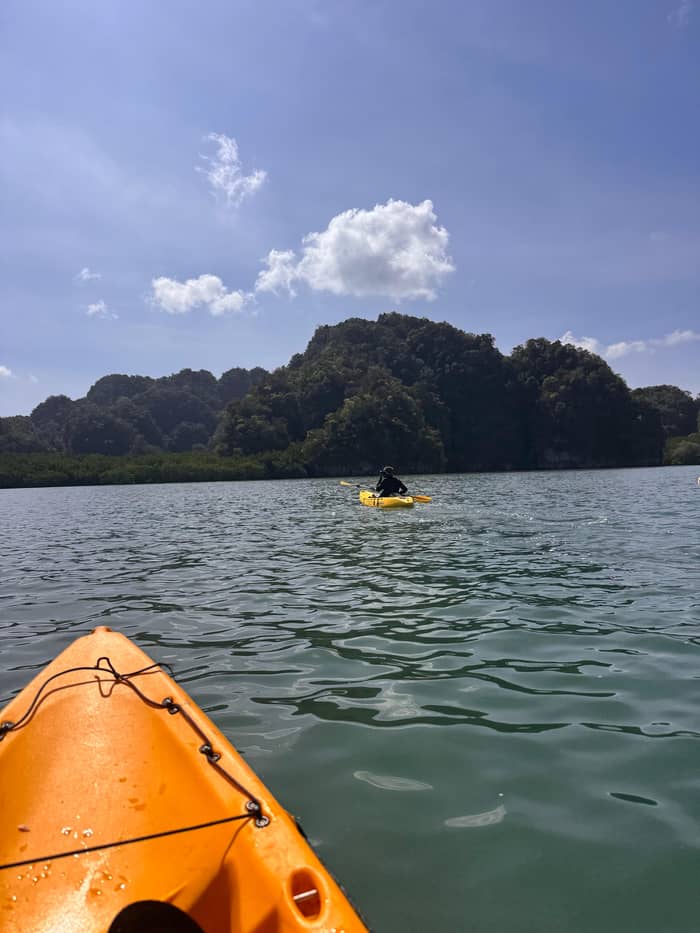
Best for first-timers
Dry and calm
December to February
- Rain31 to 75 mm
- Highs31.7 to 33.2 °C
- SeaCalmer
Hands-on checklist
List of 11 items
Check things off as you go; your progress is kept on this device.
0 / 11 ready
Everything is ready. Only the date and your pickup are left to choose.
Get a seatApril is hot and getting wetter, and the rainy season follows. See each month's heat and rain on the Krabi coast, what actually closes, and what to wear when you paddle.
Editorial team, aothalanekayak.quest · Updated November 12, 2026 · Read in 7 min
Overview
Yes, if you go in with realistic hopes. April sits at the hot end of the Krabi calendar, and it is also the month in which the rain begins to build. At the Phuket Airport station that climate files use for this coast, the average April day reaches 33.6 °C and the night falls to 24 °C, with rain on 7 days (each 2.5 mm or more) and 121 mm in all.1 That is a long way from the downpours of the wet season, but it is not the clear-sky dry heat of February either.
The park authority at nearby Than Bok Khorani describes April as mainly dry and calls the hot summer suitable for tourism, with its summer running from mid-January to April and the least rainfall in February.3,4 The same authority says its rainy season starts in late April and runs to December, with September the rainiest month.5 The sources do not disagree so much as describe a month in transition: early April is usually pleasant, late April is the doorway to the wet.
Is April a good time to visit Krabi for kayaking? Heat is the first thing to plan for. The Thai Meteorological Department's 2024 summer outlook said southern Thailand would meet more continuous rain until middle May, with heavy to very heavy rain at some places on the west coast, so a shower is plausible and a clear sky is not guaranteed.6 Book a morning slot, carry water and treat April as a hot, lively and slightly uncertain month.
The numbers below come from the Phuket Airport station that the climate file uses for this coast, with some months filled from an additional, farther station; the chart note names them. January is cool by local standards, with a daily high of 32 °C and only 31 mm of rain over 3 wet days.1 February has the fewest wet days, 2, with 34 mm of rain, and the highs reach 33.2 °C, though January's 31 mm is the lowest total.1,1 March warms to 33.6 °C and the rain starts to return, with 115 mm and 5 wet days.1
From May the pattern flips. May brings 278 mm and 14 wet days, June 343 mm and 15 wet days, and July 285 mm and 16 wet days.1,1,1 August brings 403 mm with 17 wet days, and September is the wettest, with 406 mm over 18 wet days.1,1 October is nearly as wet, with 365 mm and 18 wet days.1 Even then, the daily high stays around 31 °C, so the issue is rain and sea state, not cold.1,1
The recovery is quick. November brings 256 mm and 13 wet days, and by December it is down to 75 mm and 6 wet days, with a high of 31.7 °C.1,1 The Tourism Authority of Thailand expects the dry season proper to arrive by December on the Andaman coast, though October and early November can still be wet, and operators sometimes keep boats in port when the seas are high.7,8 For a first kayak trip, the safest window is December to March, and the shoulder weeks at either end bring fewer people.9
Rain by month
Sunless hours around mid-month and the count of days with 2.5 mm or more of precipitation. NOAA, station Phuket Airport (temperatures and rainfall for 10 months, rainfall only for 2 months) and Surat Thani (2 months), 1991 to 2020.1
No, Krabi does not close as a destination. What changes in the monsoon is the sea: the Thai Meteorological Department's outlook for the west coast said wind waves in the Andaman Sea would become more active, 2-3 meters high at some periods, as the southwest monsoon arrived.11 Island trips and open-water crossings feel that first.
Some park attractions do close. The Tourism Authority of Thailand published a national parks seasonal closure list for 2024 that gave Ao Maya, Ao Losama and Ao Loko in Hat Noppharat Thara - Mu Ko Phi Phi National Park an annual closure from 1 August to 30 September 2024.2 The Authority's autumn guide to the Andaman also says that when the monsoon swell drops the west coast comes back to life, and that the dry season proper should settle in by December.10,7
Treat any closure list as a dated snapshot. Reopening dates shift from year to year, so look up the current list before you commit to a marine park or a lagoon, and expect operators to adjust a programme for tide and weather rather than cancel outright. On a kayak day at Ao Thalane the realistic risks are a wet start and a changed route, not a locked gate. If conditions are bad, a guide will tell you, and free cancellation up to 24 hours ahead protects the booking.
Choose your month
Pick what matters most and see the months that fit.
If I want the driest weather
February or January
February has 34 mm of rain over 2 wet days.1
If I accept heat for fewer crowds
April
April reaches 33.6 °C with 7 wet days.1
If I want rain and fewer visitors
September or October
September has 406 mm over 18 wet days.1
If I want the easing of the monsoon
November
It has 256 mm and 13 wet days.1
If I want the earliest dry season
December
It falls to 75 mm and 6 wet days.1
If I can only go in the wet months
A guided mangrove trip
Programmes adjust for tide and weather.
Seasons
Best for first-timers
December to February
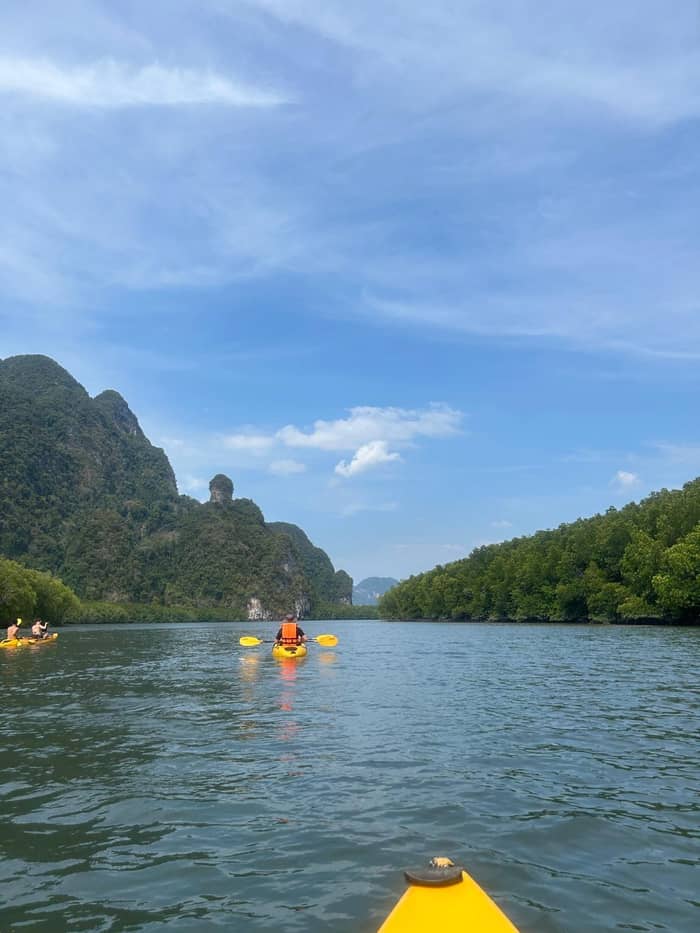
Quieter
March to April
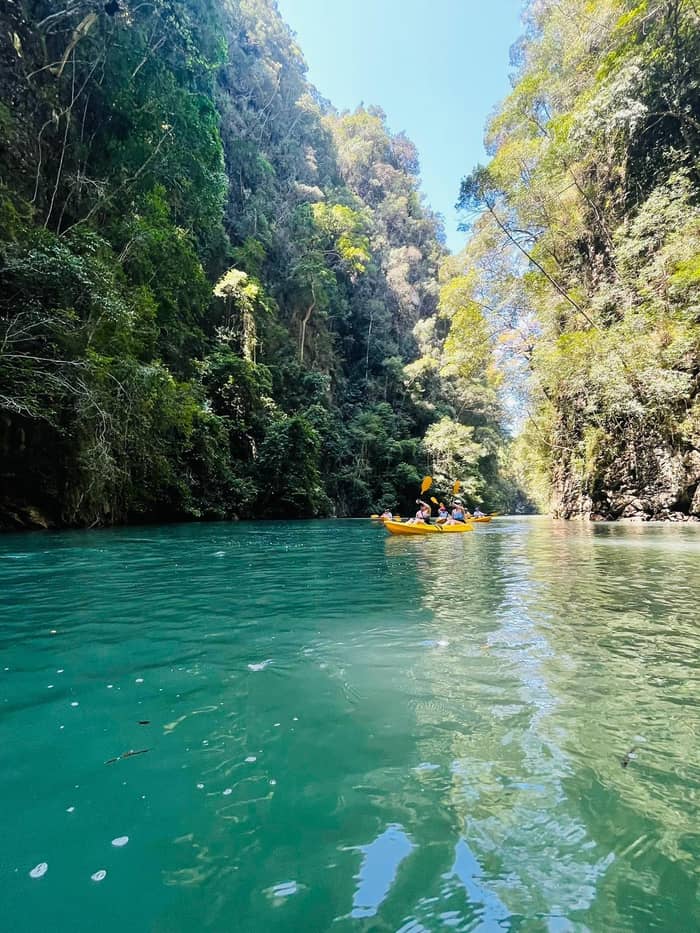
Flexible plans
May to November
The clock matters as much as the month. Tides on Thailand's Andaman coast follow a semi-diurnal rhythm, which the Food and Agriculture Organization describes as two high and low tides a day, so every session meets a different water level.14 A half-day Ao Thalane listing ties its route length to the tide. A channel that floats a kayak at high water can be a mud bank at low water.
Heat is the other variable. In March the average high reaches 33.6 °C and the sun stays above the horizon for 12.1 hrs at mid-month.1 Early and late hours are the gentlest on the water; the Klong Root listing, for instance, runs a morning session from 8:30 AM. Ask your operator for start times that match your plan and for the tide on your date.
Daylight barely moves through the year: sunrise stays between 06:07 in May and 06:43 in January, and sunset between 18:02 in November and 18:48 in July.15,16,17,18 That leaves your choice of month to rain and sea state rather than the length of the day.
Price your month
Add your group size to see the main trips priced for everyone, in any season.
Compare 3 side by side
Add your group size to see the main trips priced for everyone, in any season.
≈
View≈
View≈
ViewStarting prices from GetYourGuide, converted at the ECB reference rate. You will see the exact price when booking.
A year on the water
Dec to Mar
December settles into the dry season.7
April
April has 7 wet days and 121 mm.1
May to Jul
May has 14 wet days and 278 mm.1
Aug to Oct
September reaches 406 mm.1
November
November has 256 mm and 13 wet days.1
Back to December
December falls to 75 mm and 6 wet days.1
What to wear kayaking in the ocean is mostly a question of what can get wet. The sea-kayak listing packs a towel, swimwear, T-shirt, shorts, hat, sunscreen, camera, sunglasses and personal medication into its checklist. The Railay night listing suggests clothes that can get wet, a swimsuit with an optional T-shirt or sarong over it, and plenty of water. Think quick-dry fabric and nothing you mind soaking.
Sun protection matters more than warmth. The United States Environmental Protection Agency publishes a daily UV Index forecast of how intense the sun's ultraviolet radiation will be, and checking it before a paddle is a sensible habit.19 The Tourism Authority of Thailand adds a tip for the water itself, which is to choose a reef-safe sunscreen and keep your hands off the coral.12 A hat with a chin strap and sunglasses on a cord are worth the small effort.
Footwear is simple. Water shoes or sandals that stay on in mud suit mangrove trips better than flip-flops. Bring your valuables in a waterproof pouch, because phones and keys do not survive a capsize, and the Railay listing states that smartphones and other electronics must be waterproof. In the wet season, add a light rain layer in a dry bag. If you are on a boat or kayak, listen to the crew and wear the life jacket you are given.20,21
Video
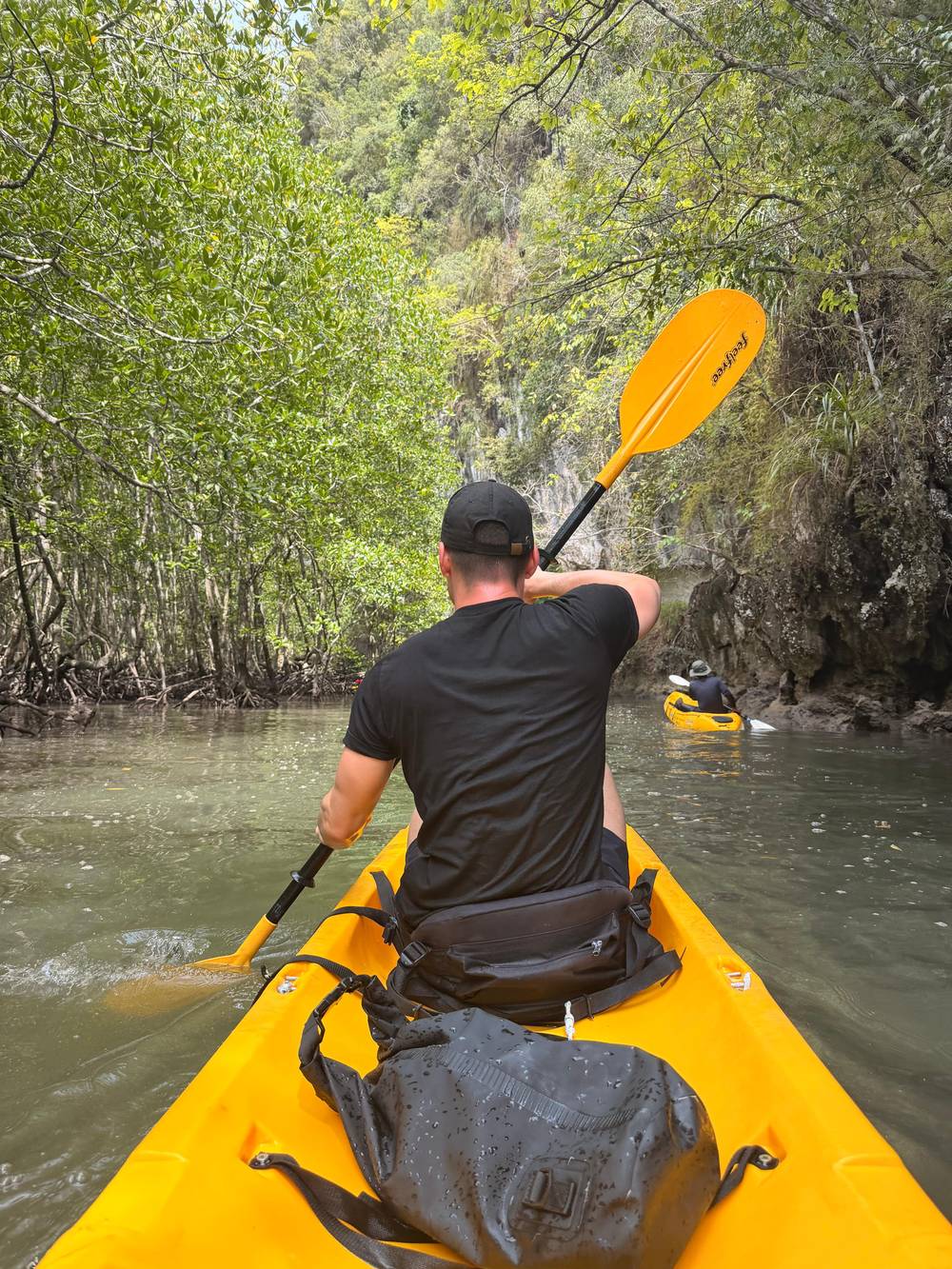
Custom Asia Travel on YouTube · Video data is requested only when you tap play.
When the monsoon swell finally drops, the Andaman Sea turns the colour of sea glass, and Thailand’s west coast comes back to life
A simple plan: choose December to March for the driest, calmest kayaking, and book early, since the Tourism Authority of Thailand advises booking ferries and island accommodation early for December and January.22 Choose April if you accept heat and a chance of showers in exchange for fewer crowds, and choose the wet months only if you are flexible and happy to paddle with a guide in the creeks.
If you travel in the rainy season, note that Thailand's tourism authority warns of extremely strong currents in rivers and near waterfalls from May to October, so stay with a guided trip and follow the guide on the day.23 The Marine Department's helpline answers on 1111, and the Tourist Police take calls on 1155.13
Finally, pick the trip that fits your date. Prices start at $24 for the mangrove kayak with pickup and $25 for the half-day Ao Thalane trip, while the home tour is from $36. Whatever the month, keep the free-cancellation window in mind, so that a forecast turning grey does not cost you the trip.
FAQ
Average April highs reach 33.6 °C, and rain builds with 7 wet days.1
Closure lists such as the Authority's 2024 list name specific park sites, so check before you go.2
It brings 406 mm over 18 wet days.1
The sea-kayak listing asks for swimwear, a T-shirt, shorts, hat, sunscreen and sunglasses.
Yes, a half-day listing ties its route length to the tide.
Yes, until 24 hours before the start, according to the home listing.
Sources
Further reading
Heading to Ao Thalane? Ask a real person here.